
What Madison County Property Tax Records Show
Every official line needs its date, jurisdiction, parcel identifier, and source attached. Madison County property tax records sit with several custodians, not one. So the strongest evidence comes from matching a single tax-map parcel across the assessment roll, the County Clerk index, the tax source, and GIS. One screen alone is never the whole story.
| Field | What It Shows | Where |
|---|---|---|
| Assessed value | Dated assessed value | municipal assessor and county Real Property Tax Services |
| Market / appraised value | Assessor’s full-market estimate | municipal assessor and county Real Property Tax Services |
| Exemptions | Applicable STAR, aged, veteran, and other exemption codes | municipal assessor and county Real Property Tax Services |
| Tax bill & status | Bill year, amount, payment, and delinquency status | Madison County Treasurer |
| Taxing districts | County, municipal, school, and other listed jurisdictions | Madison County Treasurer |
Read any official entry with its date, jurisdiction, parcel identifier, and source in hand. Custody in Madison County is split. No single office holds everything. Match the same tax-map parcel across the assessment roll, the County Clerk index, the tax source, and the GIS map. Do that before drawing conclusions. That cross-check beats trusting one record on its own.
Looking Up a Madison County Tax Bill
A tax bill lookup starts with the right identifiers. Note the date, jurisdiction, and parcel number, plus where the figure came from. Madison County splits its property tax records among custodians, so the reliable method is following one tax-map parcel across the assessment roll, the County Clerk index, the tax source, and the county GIS map. A single screen rarely settles a question.
- Search the Madison County Treasurer tax resources by address or parcel.
- Read the current bill, prior years, and payment status.
- Check exemptions applied on the assessor record.
- Note delinquency and any tax lien or pending sale.
- Assessed value
- The taxable portion.
- Mill rate / levy
- How the tax is computed.
- Homestead exemption
- Owner-occupied relief.
- Tax lien
- Claim for unpaid taxes.
Appealing a Madison County Assessment
An assessment appeal lives or dies on documentation. Keep the date, jurisdiction, parcel identifier, and source of every official line clear. Madison County property tax records are divided among custodians. Match the same tax-map parcel across the assessment roll, County Clerk index, tax source, and GIS before filing anything. Consistent evidence across offices is what persuades a review board.
Appeal window. Madison County assessment appeals must be filed by the applicable Grievance Day with the local Board of Assessment Review; a late filing may have to wait for the next cycle.
Madison County’s Assessment Calendar
County towns run on a published calendar. March 1 is the valuation date. May 1 brings the tentative roll. The fourth Tuesday in May is Grievance Day. July 1 closes with the final roll. City of Oneida sits outside that county schedule. Its parcels demand the Oneida roll and city contacts instead. Record both the valuation date and the taxable-status date for any parcel. A roll is only a dated snapshot of that moment.
How Exemptions Change Madison County Taxable Value
An assessment roll carries more than one number. Look for the land assessment and total assessment. A full-market estimate and exemption codes appear too. Separate county, municipal, and school taxable values also sit on the roll. An exemption can cut one taxable line while the total assessed value stays put. Read each code and each jurisdiction column rather than subtracting one broad figure from every tax base. Oneida rolls show how the fields differ. The 2024 and 2025 final rolls list a 71 percent uniform percentage of value. The 2021 roll stated 93 percent. That shift signals a change in assessment level. It is not proof that sale prices moved the same way.
Madison County Delinquency and Tax Searches
The Treasurer offers paid tax searches and runs the county route for delinquent taxes. County pages trace the sequence from first-year delinquency toward later enforcement and auction. Confirm the parcel, year, collector, amount, and payment status with the office itself. A current municipal bill and a county-held delinquency are two different records.
Reviewing a Madison County Assessment
New York's RP-524 process starts with the tentative assessment. It also involves the local Board of Assessment Review. The claim gets strength from comparable sales, accurate property facts, photographs, and an appraisal. Deadlines matter most. Afterward, Small Claims Assessment Review or an Article 7 proceeding may open. Each follows its own rules and dates. The state grievance source publishes the RP-524 materials.
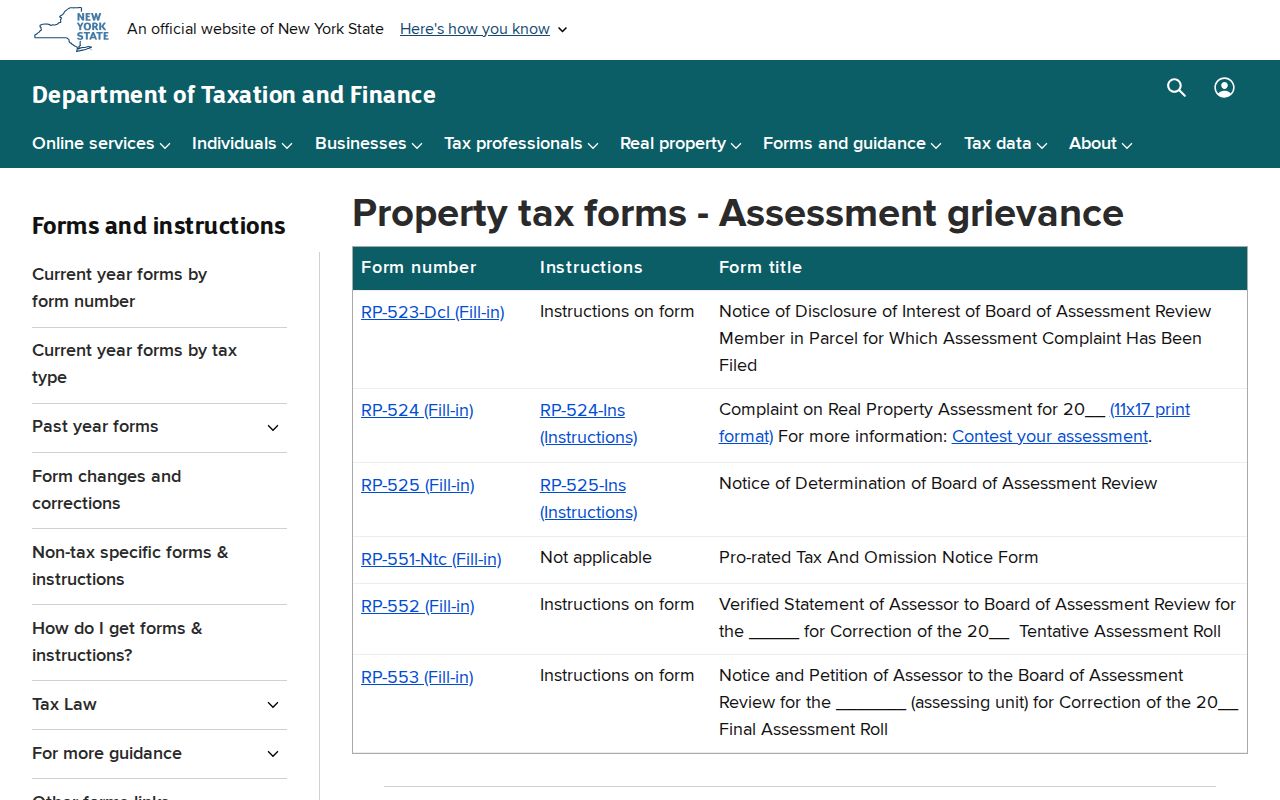
The state packet page identifies the correct forms, while the local assessor controls the parcel facts and the local filing calendar.
Reading the Madison County Tax Timeline
The county tax page explains billing, penalties, delinquency, foreclosure, advertising, and auction stages.
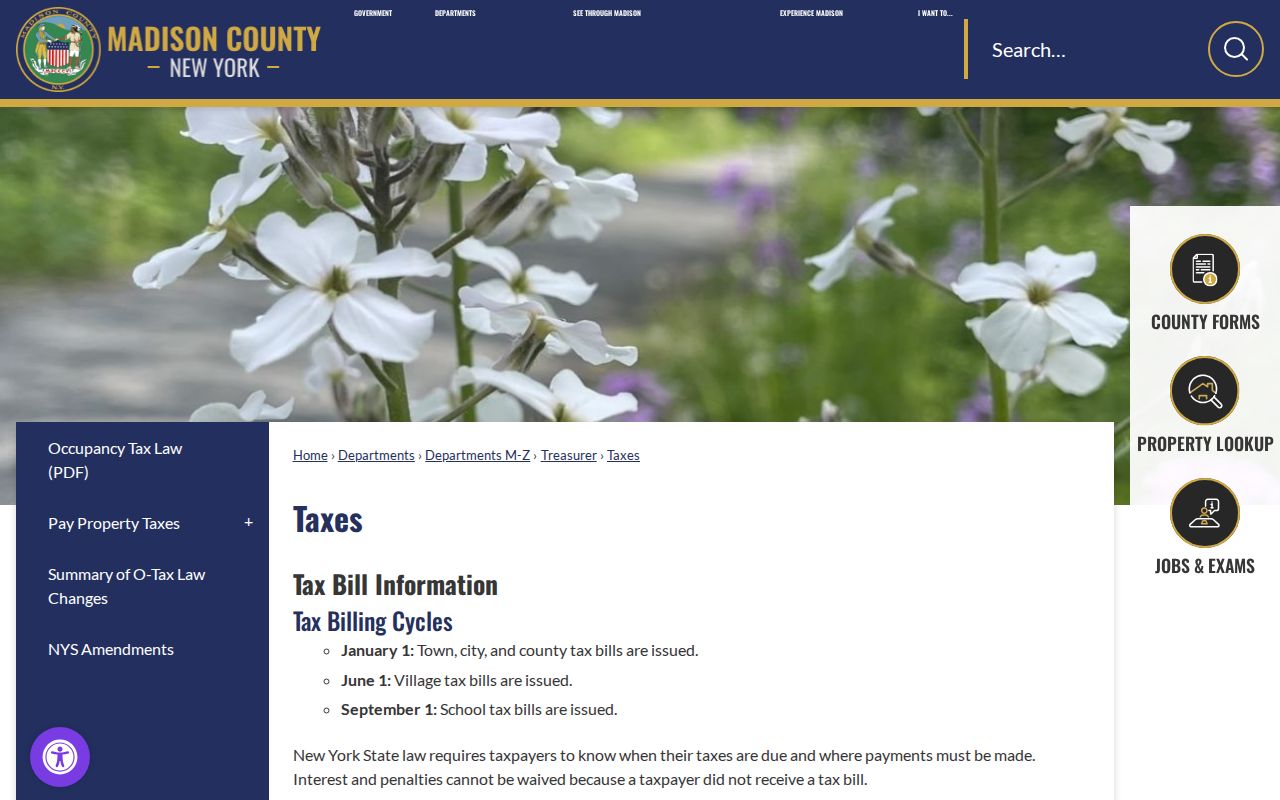
Treat the timeline as a process map, then verify the exact parcel and year with the named collector before acting. The county calculation guide points to the taxable-value fields.
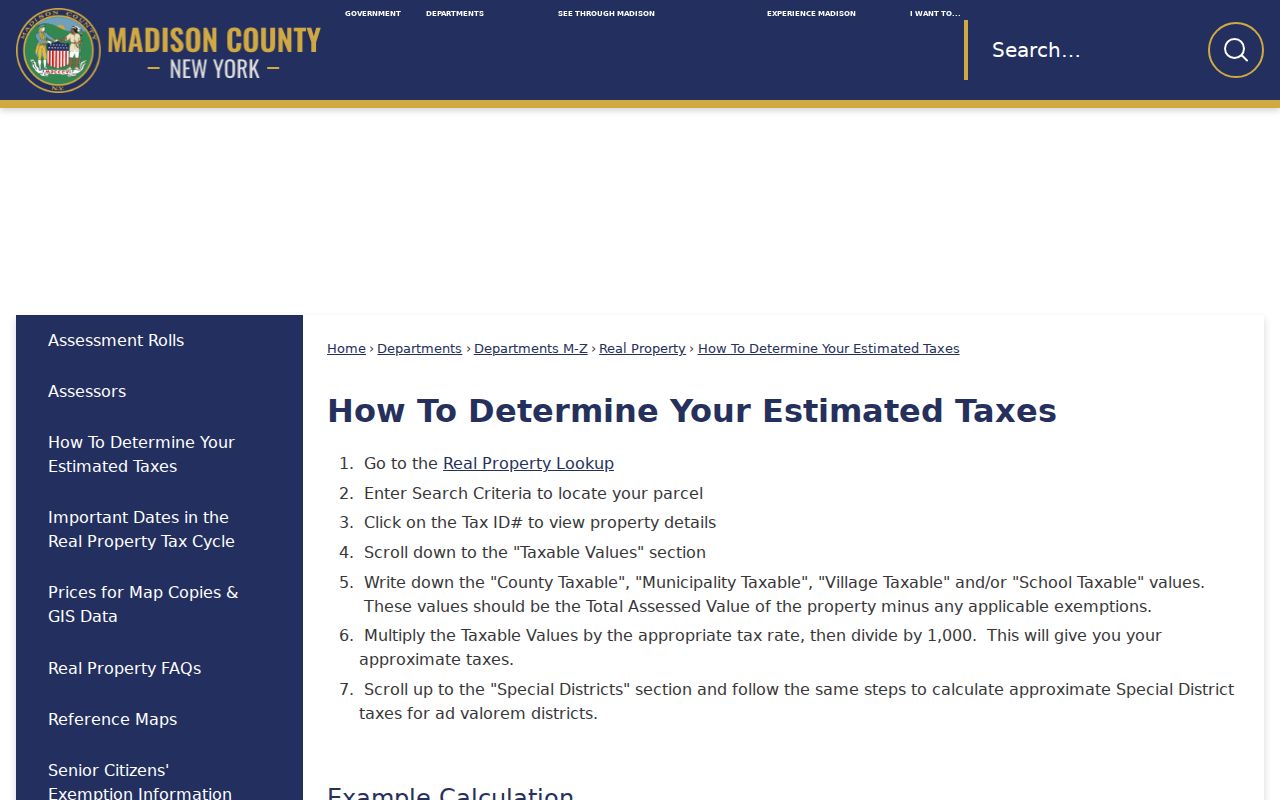
The view shows how county, town, village, and school taxable figures differ on one parcel.
Which Madison County Tax Source Controls?
Identify the municipality and tax year first. The assessor controls the assessment roll and exemptions. The tax collector shows the current bill and payment record. The Treasurer handles county functions and the delinquent-tax processes described on county pages. City of Oneida skips some county-town dates, so check a city parcel with city sources. A paid Treasurer tax search fits when a formal county search is required, and a portal view can serve for a quick look if you save it with its access date. Any payment or delinquency that could affect a transaction deserves direct confirmation with the named office.
Evidence for a Madison County Assessment Review
Start with the tentative assessment and correct the basic property facts before arguing about value. Strong evidence includes recent comparable sales, photographs, and an appraisal. Add accurate inventory details. Also bring proof of an error in acreage, class, or improvements. The RP-524 process runs through the local Board of Assessment Review. It applies on the applicable Grievance Day. Later review paths carry their own eligibility rules and deadlines. Small Claims Assessment Review and Article 7 are formal proceedings. They are not extensions of a chat with the assessor. Keep filed forms, proof of delivery, exhibits, and decisions with the parcel record.
Madison County Tax Payment Records by Year
Search the exact tax year, every time. A paid current bill says nothing about an older county delinquency, and a county delinquency screen can miss a current City of Oneida charge. Keep your receipts and confirmation numbers. Note the collector's name too. If a payment was recent, give it time to post, and confirm the status directly with the office before trusting a portal display.
Penalties come first in the county's process materials, followed by advertising, foreclosure steps, auction, and a final deed transfer. Each stage carries its own notice requirements and timeframes. One late bill never means a parcel is headed to auction. Before drawing that conclusion, confirm the current stage with the Madison County Treasurer.
Oneida Roll Dates and Madison County Comparisons
Oneida's 2025 roll rests on an August 1, 2024 valuation date. May 1, 2025 serves as the status date. The 2024 roll worked the same way, tying its year to an earlier valuation. That lag matters. A recent sale, renovation, exemption, or ownership change may not show up in the dated snapshot. Compare like roll years when checking Madison County records. Verify newer events in the deed, permit, or tax source that recorded them.