
Tracing Former Owners of a Madison County Property
Any official record deserves context. Read it with its date, jurisdiction, parcel number, and source attached. Madison County property records sit with different custodians. The strongest evidence comes from matching one tax-map parcel across the assessment roll, the County Clerk's deed index, the tax roll, and the GIS map rather than trusting a single screen.
| Source | Years It Covers | Where Held | What It Shows |
|---|---|---|---|
| Madison County IQS land-record index | 1966 to present online | Madison County Clerk and IQS | Indexed parties, dates, and instrument references |
| Older deed books and archival land records | Before 1966 | County Clerk and Historian collections | Grantor and grantee links before the online range |
| Filed maps and historic county maps | Before 1966 | County Clerk, Historian, and map collections | Lot, tract, road, and filed-map context |
| Dated assessment rolls | Before 1966 | County archives and local history collections | A dated tax snapshot, subject to deed confirmation |
Date, jurisdiction, parcel identifier, and source belong with every official record you cite. Madison County property records are divided among several custodians. So one office rarely tells the whole story. Match the same tax-map parcel across the assessment roll. Cross-check it with the County Clerk index, the tax roll, and the GIS map. That cross-check beats any lone result.
Walking the Madison County Deed Chain Backward
Every deed in the chain carries its own proof load. Check the date, the jurisdiction, the parcel identifier, and the office that holds the record. Madison County splits its property records across custodians. Solid work means matching one tax-map parcel through the assessment roll, the County Clerk's deed records, the tax roll, and the GIS map instead of leaning on one lookup.
- Find the current owner's purchase deed (owner as grantee).
- Read the prior owner (the grantor) from that deed.
- Search that prior owner as grantee to step back again.
- Note the online cutoff; continue in the deed books for earlier years.
- Grantor / grantee
- The transferor and recipient named in a deed.
- Chain of title
- The linked sequence of recorded transfers.
- Legal description
- The land description that survives street and parcel-number changes.
How Far Back Madison County Ownership Records Go
Depth of record depends on the custodian. Some Madison County property records reach back a century or more, while others start far later, so the date, jurisdiction, parcel number, and source always matter. Because records sit in different hands, the best proof ties the same tax-map parcel to the assessment roll, the County Clerk index, the tax roll, and the GIS map. One screen is never enough.
Lawful use. Former-owner research in Madison County is for house history, title research, and property diligence; using it to track or harass any living person is a crime under New York law.
The Madison County Chain Begins Online in 1966
Digitized land records reach back to 1966. Start with the current owner as grantee. Open that acquisition deed, note its grantor, then search the grantor as an earlier grantee. Record the book and page, the recording date, and the instrument type. Also note the legal description at every step.
When the chain crosses the 1966 cutoff, turn to County Clerk and Historian sources. Do not guess. Older deed and mortgage volumes, filed maps, court minutes, and historic indexes often supply the next bridge. They connect one owner of record to the next.
Parcel Splits Can Change the Trail
Roll notes can rewrite the trail. Phrases like former, split from, was part of, or includes should be copied exactly. A modern Tax ID may cover only a slice of the tract named in an older deed. Several old parcels may also have been merged into one. At that point the legal description matters most. The filed plat references matter far more than a current street address.
Probate and Estate Transfers
Death breaks many a tidy chain. When an owner of record dies, the property may pass through probate. It need not be an ordinary sale. Search the deed index for executor, administrator, trustee, estate, or referee instruments. Turn to court or probate records when the index alone does not explain who had authority to sell. The aim is recorded land evidence, never an heir guessed from a surname.
Historic Maps Explain Former Place Names
Older maps explain names that no longer exist. Madison County publishes maps dated 1838, 1852, 1853, 1874, 1889, and 1912. The Great Lots map preserves the original survey and tract terms. Farm Names records spanning 1912 through 1984 can link a named farm to an owner and town. This helps when neither the old name nor the road shows up in a current property search.
The 1864 Morrisville courthouse fire is real. Surviving records must be tested one by one. It does not mean every early chain is lost.
Paid Images and Clerk Alternatives
Index searching is free on IQS. Online images require payment after the 2023 access change. The County Clerk offers public computers. Paper copies cost 65 cents per page. Emailed copies are available per document. Those routes let a researcher verify the chain. No one should assume an index line carries the full legal description. The county archival page identifies older land and local-history holdings.
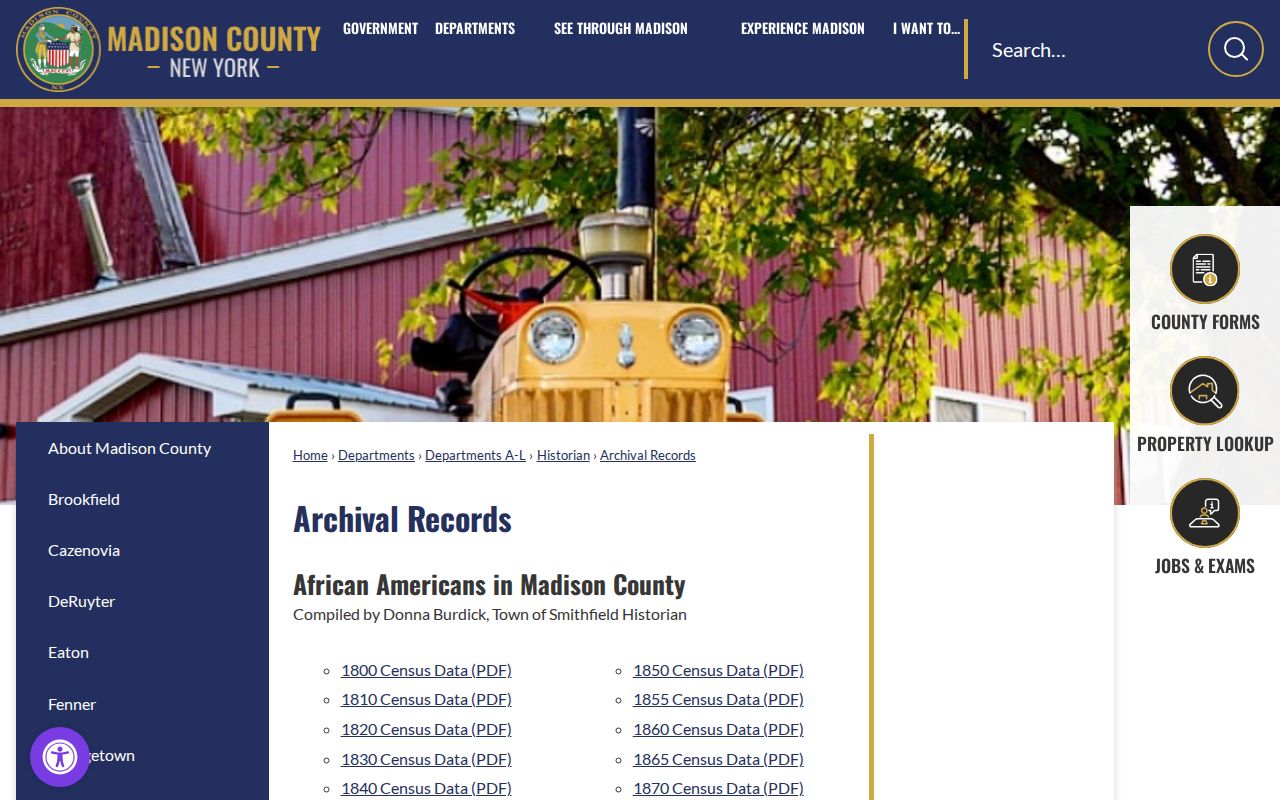
The county archival page marks the point where a former-owner search leaves the online deed index and enters the historical collections.
Quality Checks for a Madison County Ownership Chain
Test every link. Confirm the prior owner appears as grantor here and as grantee one deed earlier. Then compare the land descriptions. Save recording dates, not signing dates alone. Note partial interests, life estates, easements, corrections, and any parcel split from a larger tract. Call a gap a gap. Filling it from an unsourced family tree only buries the problem. When an archival request becomes necessary, gather the names, town, approximate years, deed references, and map clues first. The county's offline collections answer best when pointed at a specific record question.
Madison County Archive Request Details
The county's archival route moves on paper. Expect a printed request form, a check, a stamped envelope, and some advance time. Supply names, town, date range, record type, and any deed or map citations you hold. This offline path differs from ordering a recent deed image online.
Tuttle materials, veteran and burial indexes, and census sources can enrich a property history. Historic maps and farm-name records help too. Use them to support the recorded deed chain, never to replace it.